SHU and ASTA: Two Different Questions
This is the single most common source of mis-specification in chilli buying. SHU (Scoville Heat Units) measures pungency — capsaicin content, how hot the material tastes. ASTA measures extractable colour — how red it is, and how much of that colour transfers into the finished product.
They are independent. A high-ASTA, low-SHU chilli and a low-ASTA, high-SHU chilli can sit at similar prices and behave completely differently in your recipe. Specifying only one figure, or assuming that "hotter" means "redder", produces a delivery that meets the contract and fails the application.
Our whole dried chillies run 8,000 to 100,000 SHU and 60 to 160 ASTA across the variety range. Powder is blended to land at an agreed point on both scales — typically 60 to 120 ASTA and 25,000 to 50,000 SHU — by combining varieties rather than by adding anything.
HS Codes and Classification
The split between 0904.21 and 0904.22 is by physical form, not by variety or heat. Whole pods are 0904.21; the moment they are crushed or ground — flakes included — they become 0904.22. Oleoresin leaves the spice chapter altogether.
| Product | HS Code |
|---|---|
| Whole dried chillies (genus Capsicum) | 0904.21 |
| Crushed or ground chilli — powder and flakes | 0904.22 |
| Capsicum oleoresin | 1302.19 |
Stem-Cut or Stemless?
Stemless chilli has had the stalks removed, usually by hand, and costs more to produce. It is almost always worth it for grinding: stalks are woody, carry neither colour nor heat, and dilute both figures while adding to the foreign-matter count. Grinding stalks in is a quiet way to make a cheaper powder resemble a better one.
Stem-cut material — where the stalk is trimmed short but not removed — is common for food service and for buyers who will sort on arrival. Decide which you are buying before you compare two prices, because the difference between them is largely this.
Drying, Moisture and Colour Loss
Chilli is far less forgiving than turmeric. Colour fades if drying runs long, and moisture above roughly 11% invites mould once the container is sealed and the temperature starts cycling at sea.
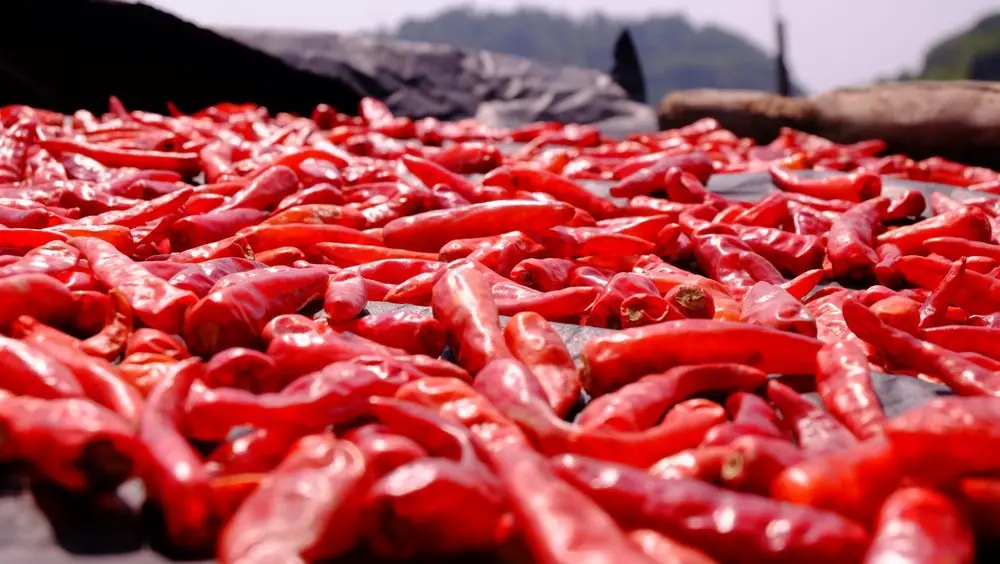
Ours is dried on open yards for five to eight days to 10–11% moisture and turned daily so colour develops evenly. The pods are then stemmed, hand-sorted to remove discoloured and broken material, and graded by size and variety before any laboratory testing is done.
Why EU Border Controls Single Out Chilli
Capsicum consignments attract more scrutiny than most spices, and for reasons worth understanding rather than resenting.
Aflatoxins and ochratoxin A are the first concern — a drying-yard crop in a humid climate is exactly the risk profile mycotoxin rules exist for. Maximum levels are set by Commission Regulation (EU) 2023/915, which replaced Regulation (EC) No 1881/2006.
Ethylene oxide is the second. Residues found in spice and additive consignments triggered extensive EU recalls, and the applicable limit under Regulation (EC) No 396/2005 is effectively at the level of determination.
Sudan dyes are the third and the most damaging to a supplier's reputation. Sudan I to IV are industrial colourings with no permitted food use, historically added to chilli powder to deepen its red. Every ground chilli lot should be screened for them as a matter of course.
Chilli may also fall under increased official controls at the border under Regulation (EU) 2019/1793, which is amended regularly.
Maximum levels are revised periodically. Always check the current consolidated text of the relevant regulation, or ask us for the limits applied to your destination market at the time of shipment.
Packing and Shipment
Bulk chilli ships pressed into 40 kg jute bales or in 25 kg PP bags, fumigated and containerised with the batch record attached. Bales are dense and freight-efficient; bags are easier to handle and to sample on arrival.
Ground chilli and flakes move in 25 kg bulk bags or retail formats from 500 g upward, with custom branding available for consumer-facing lines.
Evaluating a Chilli Offer
A supplier who answers all seven without hesitating has a process. One who answers by sending photographs of a drying yard does not.
- Which variety, and is the offer specific — Teja S17, Sannam S4, Byadgi — or just "red chilli"?
- Both SHU and ASTA quoted, as batch results rather than typicals?
- Stem-cut or stemless, and is that reflected in the price you are comparing?
- Moisture at or below 11% for whole pods?
- Aflatoxin, ochratoxin A and Sudan dye screening on the batch being offered?
- Ethylene oxide addressed if the destination is the EU?
- Correct HS code on the proforma: 0904.21 whole, 0904.22 crushed or ground?